Saturday, February 28, 2009

matchaddiction

Blast you, Chip! You got me hooked.

I cut back a lot in an effort to make my kiri-no-mori last until the replacement Yame and Yuuki Konjo arrived. As the stash dwindled to a whisper, I did a little photojournalism and will await the stream of awards.

Wednesday:
Krap... running out.
From matcha


Thursday:
Starting to look pretty grim. :/
From matcha


Friday:
Ruh roh. If I lick out the tin, I'll cut my tongue...
From matcha


Fortunately, I got the call a few hours after emptying the tin that a box had arrived today from Japan.
Suite Sister Mary! YES!!!
From matcha


Now I see a glimpse of The Way.

Empty tin = bad.

Open tin + reserve tin = good. :D

And now for a little history to view while enjoying some tea, compliments of Seven Cups:

Sunday, February 22, 2009

matcha fever

Chip over at TeaChat sent me a serving of Organic Yame Matcha to try, and I used this as a thin excuse to do something I've wanted to do for a while, buy a set of matcha prep tools (which are really just plain cool).

Chip's reaction to this?
LOL, free 2 grams of matcha cost you a bundle.

As I'd window-shopped for matcha ware before, I knew I wanted an O-Cha Matcha Starter Kit, in which I bundled a tea bowl, whisk, whisk holder, bamboo spoon, and tin of Kiri-no-Mori. I use a tea ball to strain any clumps out of the matcha powder.

From Fight Club


A number of other reputable vendors offer similar starter kits and/or the components, such as (links to the actual kits or components) Den's Tea, Yuuki-Cha, and IPPODO.

Several days later (yeah, I know, shipping) I found myself at the office making a bowl of the Yame. Ooohhhhh it was sooo goood. Seriously, matcha so far is just delicious.

So I cracked open the Kiri, which was good in a totally different way! I feel I've been employing considerable restraint by making only two or three bowls per day since then.

I made a YouTube vid of the basic process I use when making matcha at the office. It's really not tricky at all, and I honestly find it far more suited to getting my tea/caffeine fix on the go at work than other methods. I whip it up and slurp it down.


Just as tea provides a different caffeine buzz than that of coffee, matcha gives me a different high entirely. And unlike a good sencha session, late-day matcha doesn't interfere with my sleep. It just makes me feel GREAT for a few hours and then mellows back down to normal in a gradual, easy way.

Curious to read more?
Another Tea Blog: Matcha, Part 1
Another Tea Blog: Matcha, Part 2
Another Tea Blog: Matcha, Part 3

Tea Nerd: Matcha Madness, Part I
Tea Nerd: Matcha Madness, Part II
Tea Nerd: Matcha Madness, Part III

Cheap matcha tips from Matcha Man Savage

Saturday, October 4, 2008

An Ji Bai Cha from TeaSpring

An Ji Bai Cha

I've been making infusions of this one on and off since early this morning, never quite topping 180° F and varying the times from "vaguely over a minute" to "just over a minute and a half" with good, consistent results in a preheated kyusu.

A few random notes:

Very light aroma.

Clear liquid with the insinuation of yellow.

Not nearly as heavy on the palate as a lot of the good chinese green I've had this year. Lacks the buttery taste of many of those same teas.

This is a good tea to loudly slurp (OK, maybe not in the office during normal hours) to get a fuller sense of it.

According to the vendor, "Research found that the tea plant has low chlorophyll and polyphenols content (which explains the whitish-green tea leaves) but is very rich in amino acids. It has almost twice the amount comparing to other green teas. Amino acid helps suppress cortisol and reduces stress."

I can't confirm the scientific content, but I have found this to be a relaxing tea on a stressful day.

Saturday, September 27, 2008

En Shi Yu Lu steamed Chinese green from TeaSpring

The en shi yu lu leaf appearance is similar to sencha (presumably from the steaming process), but definitely not quite the same. But I couldn't quite put my finger on the difference until I placed them side by side.

Whereas sencha leaf tends to have a needle-like appearance, this tea's needles are a little gnarly and bent in a subtle way. A heavy, delicious aroma like a first class dragonwell wafted up from the bag during the pour.

155°F
preheated kyusu
1 minute
2 grams of leaf
150 ml of water

Color and initial flavor remind me immediately of a high quality long jing. The first sip, however, left me with an impression of warm butter (real butter, not the fake, flavorless stuff).

The color of the brew is bright yellow, with no discernible dust or hint of darkness.

Friday, September 26, 2008

Huang Jin Gui oolong from Teaspring

For the first time since I got this latest batch in from TeaSpring, I had a challenge dialing in a tea today: Huang Jin Gui oolong.

I started off with 4.8 grams of leaf in a preheated yixing, boiling water, 1 minute, like most other teas I've had this week.

The scent was moderately thick and floral. The color was sort of a tinted amber with a hint of green. And there was more tea dust in the cup than other teas I've had lately.

The flavor was subtle and crept up on me over a few sips. A cool, refreshing mouth feel was immediately evident. There was a perfume-like quality to it, but not to outrageous excess.

It reminded me of a jade oolong. If I'd had to guess blind, I'd have tagged it as straight from Taiwan (and would've been mistaken, as it's from An Xi, Fujian Province).

After several infusions, I finally tried just reducing the steep time by about half in a cool pot, producing a more agreeable brew. Next time, I may try a more gong fu influenced approach with ultra-short steeps.

There's honestly nothing wrong with this tea. It's just not my personal style.

However, I think it may prove quite worthy with some tinkering, and is certainly a candidate for blending to lend some of its enjoyable qualities to some other tea.

Thursday, September 25, 2008

Ya Bao from Teaspring

This morning's Ya Bao turned out to be an unusually pleasant surprise.

I've had a good bit of pu-erh, and this was unlike any I've tried to date. In fact, it reminded me more of a really flavorful white tea.

I used 5 grams in a preheated yixing pot with boiling water for 1 minute. After several infusions I ramped it up to a minute and a half with no negative impact.

The color was light, and the taste was sweet & pleasant.

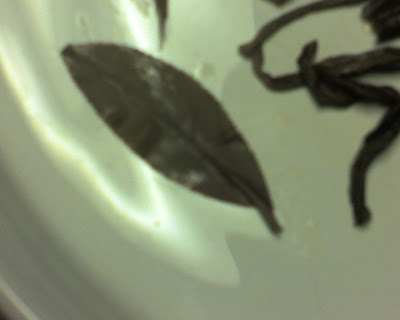
The dry leaf looked nothing like other loose tea leaves I've seen, but my phone cam took a really inadequate picture. The vendor has some pretty good pics, which may be found via the link above.

Wednesday, September 24, 2008

Feng Huang Dan Cong from Teaspring

This morning I tore into the Feng Huang Dan Cong that came in my big Teaspring order.

Contrasting it with yesterday's Bi Luo Chun Hong Cha is easy enough at a glance.

From Fight Club


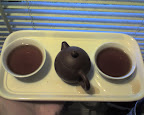
In this picture, the BLCHC is on the left, and the FHDC is on the right.

The BLCHC is twisted up into tight little nuggets, whereas the FHDC is on the verge of being impractical to handle with a spoon.

I weighed out 3.1 grams and steeped about half a minute in a yixing slightly less preheated than normal in water just below boiling.

It came out amber, unlike the deep brown of most of yesterday's BLCHC infusions. I found the taste bright and complex, with a cool sensation that may have been astringency. In comparison with this, the Bi Luo Chun Hong Cha eats like a meal.

Subsequent infusions over the next several hours continued to produce satisfying cups of tea. I changed up the temp and steep time semi-randomly and was just couldn't make a bad cup.

At the end of the work day, I took the following pic of one of the wet leaves.

From Fight Club

Tuesday, September 23, 2008

Bi Luo Chun Hong Cha from Teaspring

Last night I came home to my long-awaited shipment from Teaspring!

So this morning I was able to start my work day with some Bi Luo Chun Hong Cha, a welcome change of pace from the green tea I've been drinking to the near exclusion of other teas for the last several months.

I figured Teaspring's brewing suggestions were bogus based on the fact that they say to start out with 212°F water and increase temperature with subsequent infusions (For the science-disinterested, that's not exactly something easily done in the average kitchen.)

So I measured out a rounded, but not heaping, spoon of leaf weighing in at 4.8 grams into my preheated yixing pot. I didn't rinse the tea, as this isn't that kind, but made the first infusion really short to err on the side of caution. (Every now and again you can destroy a perfectly good cup of tea on the first infusion if you try hard enough.)

The color, flavor, and aroma were much to my liking, but I decided longer infusions were in order.

Most of my infusions were probably in the 30-second range, but I guesstimated instead of using a timer.

I eventually lost count of the number of infusions, but kept it coming until early afternoon. The tea prevailed!

This is a great little black to shove in your tea hole.

Saturday, August 23, 2008

What Is Genmai Cha with Matcha, and How To Brew It


Genmai cha is roasted/toasted brown rice kernels and bancha green tea. The bancha has a less refined flavor than some of the more exotic Japanese green teas and mixes well with the nutty, aromatic qualities of the cooked rice.

In the rice cooking process, some kernels pop, leading to the nickname "popcorn tea" used by nobody I know personally but seen in marketing propaganda.

The matcha green tea powder adds more essential green tea characteristics to balance out the rice notes, which some people don't like as much in traditional genmai.

It's inexpensive, easy to brew, forgiving of mistakes in the brewing process in comparison with some other, more esoteric Japanese green teas.

Brew at 175° F in 6-8 oz. of water for a minute and a half, up to 2 minutes in a pre-heated kyuusu (or kyusu, if you prefer) with the lid off.

Konghea Assam "Golden Bud"

I was just rooting around in some pu'erh and found this sample that must've fallen into effective invisibility among the larger Hou De bags.

So I preheated a kyusu, and spooned 4.8 grams of leaf to several ounces of water cooled down slightly from a rolling boil to infuse for 3 minutes.


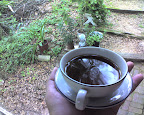
The result was the fine cup of tea shown here.

It's a thick, dark brew with a clean, earthy smell. While I love my white, yellow, and green tea, I was raised on strong tea the Southern tradition, and this one hits the spot.

I love happy accidents!

Late 80's Meng Hai 8972 Brick Uncooked (from Hou De)

According to Hou De, this is a "blend of early 80s and late 80's leaves" produced "1989~early '90s".


I preheated my trusty yixing pot and rinsed 3.6 g of brick. The rinse was as clean a rinse as I've ever seen.

I didn't pull out the clock for this session, but thumbnailed my infusion timing.

The first steep was pretty highly aromatic, with a scent that gave me a better idea of what shu-producers must be shooting for. Only this didn't have the funk and gunk I normally associate with even good shu.


The second infusion was mellower, less aromatic, and seemed very well-balanced. The third has continued this trend.

I'm sipping this tea for breakfast, and I think that may be an ideal application for it. Historically, I've found many breakfast teas to be way too aromatic and heavy, but this is closer to the sweet spot.

I have enough left for a few more sessions, fortunately, and look forward to them. I may take these to the office for good day-starters.

Friday, July 4, 2008

tea at Saigon

# El Padre - 4:37: At the vietnamese place where we had lunch today, they brought me hot water and a tea cup that looked like a diner-style gaiwan-ish cup

# El Padre - 4:38: I pulled out the xu fu long ya and weighed out 2.1 grams, and proceeded to make some tea

# El Padre - 4:38: in the porcelain gaiwan salsero gave me

# Ed - 4:38: lol you brought your scale?

# El Padre - 4:38: The waiter wanted to try my tea after smelling that first flush yummy fresh smell

# Ed - 4:39: :)

# El Padre - 4:39: yup, the digital scale, also from salsero heh

# Ed - 4:39: lol

# El Padre - 4:39: my lunching partner said if I had pulled that stuff out at any other kind of restaurant, he'd have walked the **** out

# Ed - 4:41: lol dre... if I saw a dood pull out a scale in an eatery, I'd probably go ask him for a dimebag

Saturday, May 17, 2008

current teas and other tasty beverage treats

This week, I've divided my tea time between 2008 Emperor Long Jing from Teaspring on the hyper-fresh end, through the spectrum to include some Phoenix Bird Oolong from Mighty Leaf (which I enjoyed more than most oolongs I've tried over the last several months). But I've also dipped into staples like genmai cha and (this morning) Citron Green from Adagio.

Tea is not my only tasty beverage, but it's really my default beverage of choice for daily activities. It's caffeinated, but tends not to be ridiculously so. (Oh, but the exceptions! Some sleepless nights can result from unwary overconsumption of sencha too late in the day.)

I like to delve into the different when I can, which is one of the treats of the local Vietnamese restaurant. There one can find many cool things to sip, including durian, lychee, mango/avocado (not to be missed, that one), papaya, or even what I had last night: a milk egg soda. (It was what it sounds like, but I enjoyed it quite a bit.)

With a few exceptions, like the iced tea we drink here in Mississippi and Thai tea, I don't take sweeteners in my tea. I find the stuff sweet enough, as a rule. Same for yerba mate.

Now, coffee's a different story. Unless I can find something like a nice Hawaiian kona, I generally like to turn my coffee into a dessert. Adding contrasting flavors can help highlight that which is enjoyable in a mediocre coffee, and mediocrity is abundant in the coffee world.

I guess there's plenty of tea mediocrity, as well. It's just so easy to find superior tea that I don't bother with the crappy stuff much any more.

Friday, May 2, 2008

first flush fever

I'd like to say I've been enjoying some first flush green tea lately, but "enjoy" just doesn't get it.

When the first freshly-harvested green teas began to hit the part of the tea market I frequent, I went to teaspring.com and just ordered up 25 grams of each first flush green they had available, and 50 grams of meng ding huang ya, a yellow tea that rocks my socks.

In the last few weeks I've killed off the huang ya and lion xi hu long jing, and have just broken out the zhu ye qing this evening.

This stuff is just about inexpressibly good. Fresher is just plain better.

The zhu ye qing is the wild card so far, and I had no idea what to expect. But when I pried open the sealed pouch, a thick, luscious aroma danced up at me. Wow. Then the taste of the tea itself. Mmmmm.

I've been steeping all of these in the 70-80° C range for a minute or two, repeatedly until I feel content or otherwise diverted. They hold up unbelievably well.

Get some, dammit, and feel the love.

Sunday, March 30, 2008

Mighty Leaf Kyoto Rice

Genmai cha is a Japanese green tea with roasted rice kernels (some of which pop like popcorn during the process) historically said to have been an innovation of people who could not afford the luxury of costly tea without introducing rice as a filler.

Some modern people, myself included, drink genmai cha not for economic reasons, but because we enjoy the aroma, color, flavor, and (for some people) reduced caffeine it offers. I have not verified that it is less caffeinated in any scientific way, but it makes sufficient sense for me not to question it.

Kyoto Rice is Mighty Leaf's branding of this traditional infusion. I have enjoyed a few cups now, brewed in the neighborhood of 170° F for 2.5 minutes or so, and find it quite satisfying.

When I enjoy genmai cha (which I have done for years now), I look for certain signature traits. The aroma should be pleasant and inviting. The infusion should be an insanely bright yellow. It should settle in my stomach in a warm, soothing way. The texture should be like a liquid interpretation of satin.

Kyoto Rice meets all these standards. But the sample I received did not seem to contain any dust or other tiny particles that can soil an otherwise good cup of genmai cha. I hope this is the case for all of their Kyoto Rice, because when a vendor sends me dusty genmai, it consistently produces an inferior cup of tea.

Although I prefer to prepare cups of no more than 4 oz. of most teas, a good genmai cha is one you can make by the cup or mug full and enjoy with a meal or snack.

Like most genmai cha I've enjoyed, Kyoto Rice was good for a second infusion. I don't generally go for a third with this type, because I find that after the combined infusion time of a few cups, diminishing returns may be noted. But this is something of a casual observation, and I encourage you to find your own happy place with this fine and versatile beverage.

Friday, March 28, 2008

Mighty Leaf Deep Roast Sencha

When rummaging through my stash for some weekend review ideas last night, I stumbled on this little gem. I hadn't tried it for the same reasons I haven't been doing many review tastings at all lately: office construction and illness. (Between the two, I've had few chances to really appreciate the subtleties of unfamiliar quality teas lately.)

When I first saw this one, I was honestly a bit puzzled. Other roasted teas I've seen have been brown, and this is a rich, deep green. Plus, steamed sencha is all the rage among my fanatical sencha clique. I didn't really know what to expect.

It turned out to be essentially indistinguishable from a good fukamushi in my book, which I consider a good thing. It's got more of a kick, I feel, than the same vendor's Shincha, which I found robust and yummy.

The first steep, like those of its deep steamed cousins, was the "wake up" infusion, flavorful in comparison with other greens, but nothing compared to the awesome payload of flavor administered in subsequent infusions.

I took a pic of the second infusion, which lasted literally only a few seconds:


My camera just doesn't do justice to the green teas I love, but perhaps you can see why some of us invoke the name of Kermit the Frog in reference to this class of teas.

I loved the flavor of this and following infusions. And, also like a fukamushi, I received a caffeine rush of biblical proportions.

Wow, was this tea good. I give it two muppets up.

Saturday, March 22, 2008

Mighty Leaf Dragonwell Tasting

Mighty Leaf sent me several samples recently, and the Shincha sample impressed (see recent sencha post), so I've been looking forward to hitting the Dragonwell.

The leaf had a good appearance, looking colorful and vaguely healthy. Eyeball measurement told me I should be able to have at least 2 sessions with it.

This morning I gave it what I consider a standard dragonwell treatment: infuse one teaspoon (not heaping, but all that cares to come out on the spoon) in preheated kyusu at 170° for a hair over two and a half minutes.

The resulting brew came out bright yellow and inviting, with a pleasant aroma.

The first sip was immediately flavorful. Some dragonwell is more subtle, and some just doesn't work out, but this was just plain good. During part of the first cup, I had some oatmeal with dried peaches (hey, don't knock it), and find myself thinking this tea has good prospects as a breakfast tea. (Haven't tried it with huevos con chorizo yet, so the final verdict is out!)

I bumped the heat up to 180° for the second steep, but was unable to make detailed tasting notes due to having just inhaled it. But it takes a good tea to inspire such an attack, so add points for this aspect of the tasting experience.

The third cup is mellow and pleasant, capping off an enjoyable session.

Follow-up edit:
I had initially entitled this "Tasting 1" but was thwarted in my attempt at a second tasting. I broke it out earlier this week for a second session at the office, but construction workers came by and started painting. The potent chemicals in the air completely wrecked the entire session and made me rather violently ill.

I'll have to sum up by recommending this as a perfectly good dragonwell for anyone on the cusp of trying it and looking for an excuse. I liked it.

Monday, March 17, 2008

sipping on some sencha

I've been hooked on sencha since that first ineptly-infused cup. At its best, sencha is wickedly good.

Right from the start I found myself on a mission. I asked sencha fanatics, "If I could only have one sencha for the rest of my life, which one would you suggest?"

Answers came.

Sencha lovers, if opportunity allows, will really geek out on you. So it's not hard to learn a few things.

Fast forward, and I've had countless cups of some seriously good steamed green tea from Japan.

The word "sencha" doesn't encapsulate a single, two-dimensional tea experience. Sencha can be fresh, buttery, grassy, astringent, and more, in varying degrees and depths of expression.

O-Cha's Uji Sencha Miyabi, for instance, can be fresh, and potent, even capable of relieving congestion in my upper respiratory system when the mojo is on.

Den's Sencha Den, Hibiki-An's Sencha Superior, andAdagio's Sencha Premier are less intense, but still complex and yummy.

Some, like Den's Fukamushi-Sencha Maki and Mighty Leaf Tea's Shincha will shove you in the trunk, drive you to the docks, and hurl you into a river of flavor.

Friendly advice to senchadventurers: Evil faeries sneak in to tea vendors' supplies and work their magic to play tricks on you with instructions psychotically suggesting that you prepare your sencha in a particle accelerator. Or worse yet, they have been known to trick people into steeping sencha for three minutes.

Madness!

Depending on the sencha, the first infusion is quite often less than a minute, and some times significantly less. This infusion is generally milder than subsequent infusions.

The second infusion for me is usually over nearly as soon as I pour hot water into the pot. No, seriously. We're talking seconds here.

I go longer for milder variants, but do not dally when fukamushi is involved. This second cup will tend to be stronger, more aromatic, and in some cases eerily reminiscent of Kermit the Frog.

Third (and subsequent, in some cases) steeps can be longer and/or a bit hotter, depending on personal taste.

A cup of sencha can be a truly sublime experience during an otherwise very hard day. I can hardly do it justice here.

My advice? Get some. Get *lots* in great variety.

And at the time of this writing, the first sencha of the year will soon be plucked, shipped and finally sipped by some lucky soul. Why not you?

Friday, February 29, 2008

just4tea.com Dragonwell

It's taken me longer than expected to get this review up, since just4tea sent me the tea to taste a few weeks back. However, I have kind words to say.

They sent enough of a sample for me to get a little creative. I tried brewing some strictly according to the instructions on the pouch, and was pleased with the result (which runs contrary to vendors generally providing *miserable* brewing instructions with their tea), then overbrewing some just to see what would come of it.

The overbrewed tea was pleasant and drinkable, and I snarfed it down cheerfully.

But the tea I made following their instructions turned out to be some perfectly good dragonwell. In fact, it actually reminded me of a good yellow tea!

Off-hand, I'd recommend this as a good introduction to loose green tea, and long jing lovers like me can appreciate it as well.

I was unable to find any points of criticism.

Thursday, February 14, 2008

Sencha Den

I'm currently enjoying a cup of Sencha Den, a sencha blend from Den's Tea sold only in a 3.5 ounce vacuum-sealed tin.

It's not as intense as some of the other senchas I usually enjoy (Fukamushi and O-Cha's Miyabi), but I'm loving it already.

The smell when I first broke the seal was complex and suggestive. It made me want to get right on with the preparations for tea.

I disregarded the brewing instructions on the side of the container and used a level teaspoon of leaf in 4 oz of water just under 180* in a preheated kyuusu for about a minute.

The color was bright yellow with just a whisper of green tint and very clear.

The taste was not explosive, but full, fresh, and bright. A sensation of coolness filled my mouth, throat, and entire torso by the time I finished the cup.

It was then that I noticed the most outstanding feature. Prior to brewing, I had felt exhausted and lethargic due to work stress and lack of good sleep for days. In a span of several minutes, though, I felt great. Not hyper, or giddy, but just plain good.

For the second cup, I brewed for a full 45 seconds, and the color remained in the bright yellow range, but more dense.

The flavor remained fresh and interesting, and about half-way through the cup I decided to start this entry while the impressions are fresh on my palate.

One of the TeaChat guys asked (repeatedly) if I detect tinny or woody flavors, presumably based on some previous experience of his. I haven't noticed these yet, but it's late in the day, and my palate may be too exhausted to pick out something I may well notice in the morning.

I'll keep an eye out for both the good and the bad. So far, though, my impression is that this is a good tea for the price, and I look forward to more tomorrow.